Universities Racing Toward the Future While Losing the Human
By Admin on Jan 01, 2026 288x dibaca
Across the world, universities are running fast. They race to adopt artificial intelligence, climb global rankings, forge industry partnerships, and brand their graduates as “job-ready” citizens of the future. Lecture halls echo with phrases like future skills, global competitiveness, industry relevance, and innovation ecosystems. On the surface, this looks like progress. Modern. Efficient. Visionary.
Yet beneath this spectacle of advancement, a deeper anxiety is growing quietly but persistently: are universities still educating human beings, or have they become sophisticated factories producing skilled workers without moral direction?
This is not a local concern. It is a global one.
From elite campuses in North America and Europe to emerging global universities in Asia and the Muslim world, higher education is increasingly framed as a technical project: measurable, accelerated, and optimized. Students are viewed as outputs. Lecturers as delivery systems. Knowledge as a commodity. Education becomes successful when it is fast, efficient, and market aligned.
But education, at its core, was never meant to be merely efficient. It was meant to be formative.
The world’s leading universities those often celebrated as the best did not earn their stature merely by producing employable graduates. Institutions like Oxford, Harvard, or Tokyo University became global references because they cultivated thinkers, leaders, critics, and moral agents. Their legacy was not only innovation, but intellectual conscience. Their graduates were not only skilled but grounded in purpose, responsibility, and public ethics.
Today, that legacy is under strain.
Artificial intelligence has accelerated this tension. AI, once imagined as a tool to assist thinking, is now often treated as a symbol of absolute progress. Universities rush to integrate it into teaching, assessment, and research not always with reflection, but with urgency. Efficiency becomes the goal. Speed becomes virtue. Automation becomes achievement.
Yet technology is never neutral.
Without ethical orientation, AI risks amplifying the most dangerous trend in higher education: dehumanization. Learning becomes faster, but wisdom becomes thinner. Information multiplies, but meaning erodes. Students become highly capable, yet ethically disoriented fluent in systems, but alienated from social empathy and moral courage.
This phenomenon is not confined to the West or the Global North. It is increasingly visible in transnational institutions across Southeast Asia, the Middle East, and the Muslim world—including universities carrying strong religious and moral legacies.
Universities affiliated with faith-based movements face a particularly critical moment.
Take Universitas Muhammadiyah Malaysia (UMAM) as an example. Positioned within the global academic landscape, UMAM stands at a decisive crossroads. On one hand, it is expected to meet international standards: rankings, digitalization, global employability, and research metrics. On the other hand, it carries a profound ideological mandate rooted in Muhammadiyah’s tradition of tajdid renewal with moral clarity.
The question, then, is not whether UMAM can compete globally. That is a technical question and likely answerable.
The deeper question is this: what kind of global university does it aspire to be?
If global competitiveness becomes the ultimate goal, universities religious or otherwise will inevitably sacrifice something essential. Local wisdom is side-lined. Ethical education becomes peripheral. Identity becomes branding rather than substance. “Job-ready” replaces “value-ready.”
And when that happens, higher education quietly submits to market logic, not civilizational responsibility.
If artificial intelligence is understood merely as an efficiency tool, campuses risk becoming high-tech credential factories. Students are trained to operate systems, analyse data, and adapt to digital economies but remain disconnected from social injustice, spiritual depth, and ethical accountability. They learn to answer questions, but not to question power. They master tools, but lose direction.
In such a model, success is measured narrowly: employment rates, salary data, ranking positions, and citation counts. These indicators matter but they become dangerous when treated as the sole purpose of education. Universities stop asking whether graduates become responsible citizens, ethical leaders, or compassionate human beings.
History teaches us otherwise.
The greatest universities in the world were not built on market obedience alone. They were built on intellectual courage on the willingness to challenge dominant paradigms, critique unjust systems, and nurture moral imagination. They produced not only professionals, but public thinkers.
For institutions like UMAM, this is not a limitation it is an opportunity.
Carrying the Muhammadiyah name means inheriting a tradition that views education as enlightenment (pencerahan), not mere training. Technology, rankings, and global partnerships need not be rejected but they must be subordinated to values, not the other way around.
AI should serve ethical reasoning, not replace it. Global metrics should inform quality, not define meaning. Internationalization should expand moral horizons, not dilute identity.
A truly global university is not one that imitates others flawlessly, but one that contributes something distinct to global civilization.
For Muslim universities in the global arena, the test is profound: can they offer a model of modern education that remains deeply human, ethically grounded, and spiritually conscious?
Without this courage, religious universities risk becoming replicas global in appearance, empty in essence. The label “Islamic” becomes symbolic, while educational practice follows the same neoliberal logic that reduces education to productivity.
|This is the real danger facing higher education today: campuses that are advanced in systems, but impoverished in vision.
At this moment, criticism is not hostility it is responsibility.
Universities, including Universitas Muhammadiyah Malaysia, must resist the temptation to equate progress with speed, intelligence with automation, and success with rankings alone. Education is not merely about preparing students for jobs it is about preparing them for humanity.
Human beings who think critically. Who act ethically? Who dare to question injustice? Who understand that technology without conscience is not progress, but peril?
If universities neglect this mission, then global recognition and technological sophistication become hollow achievements beautiful on the surface, fragile at the core. A campus may stand proudly among world rankings, yet fail its most fundamental duty: to humanize humans.
And when that happens, the university has already lost no matter how high it climbs.
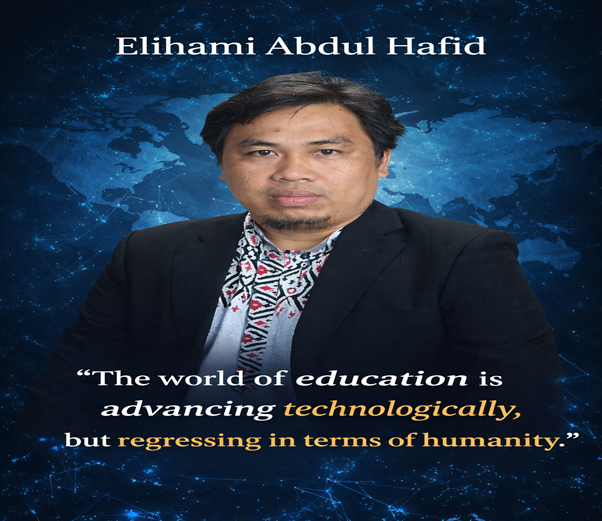
By: Elihami Abdul Hafid (Universitas Muhammadiyah Malaysia)